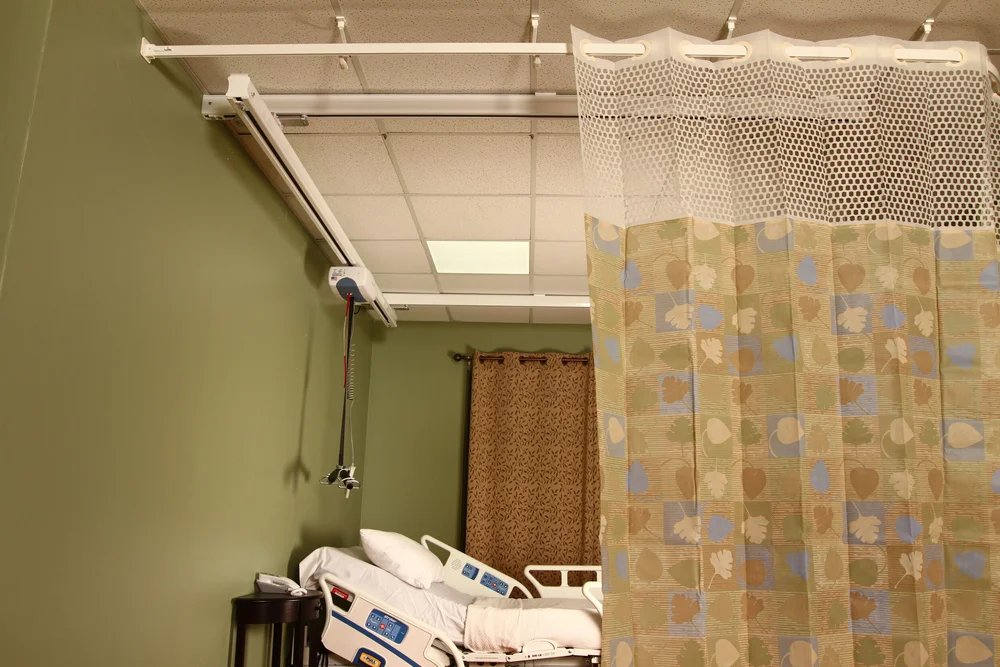
When installing a privacy curtain around a hospital bed, it is not enough to just consider the length of the curtain. The layout of the room, the position of the bed, the shape of the track, and the desired privacy coverage are also important.
If the curtain is too short, the patient may not get complete visual privacy. If it is too long, it can be difficult to move and maintain. That is why it is best to properly measure the space and existing track before purchasing.
What Size Curtain Fits My Bed or Room?
There is no one standard size that is suitable for every hospital bed or room. The required curtain size depends on where the bed is placed, where the track is installed, and how much privacy is desired.
Typically, the curtain needs to follow the track around the bed. Therefore, it is more useful to first determine the total length and shape of the track.
When measuring a room, consider these things:
- Bed position
- Total length of track
- Ceiling height
- Required curtain drop
- Privacy coverage
- Curtain opening and closing space
If the room already has a track, it can be easier to determine curtain dimensions based on that track.
Start with the Track
The size of a hospital privacy curtain often depends more on the track than the bed. For example, if a ceiling-mounted track is installed around the bed, the curtain must cover the entire route of this track. If the track is on only one side of the bed, the required curtain length will also be different.
Therefore, it is not advisable to order curtains by measuring only the width of the bed. First, look at the configuration of the existing track. If the project is new, it is better to plan the curtain and track together. technical specifications and CAD files can be useful in this process because they help to understand the track layout, dimensions, and installation details in advance.
Think About Curtain Drop
Curtain length is not just a horizontal measurement. Its vertical drop is also important. The curtain should be long enough to provide the desired privacy coverage. A drop that is too short will not fully cover the patient area.
On the other hand, the curtain should not drag on the floor. Excess fabric can create problems with cleaning and daily movement. Therefore, when selecting the height of the curtain, the ceiling, track position, and floor level should be considered together.
Room Layout Changes the Answer
The curtain requirements for a small examination area and a large patient room will not be the same. If the room has one bed and the track is only around it, the required size of the curtain may be relatively simple.
However, if there are several beds in a shared room, a separate configuration may be required for each privacy area.
Doors, cabinets, medical equipment, and other fixed objects can also affect curtain movement. Before ordering a curtain, it is best to check whether there is enough space to open and close it completely.
How Much Privacy Do You Need?
The decision on curtain size is also tied to privacy requirements. If the goal is to cover only one side of the bed, a small curtain may be sufficient. However, if the entire patient area needs to be visually separated, more coverage will be needed.
Privacy in healthcare environments can be especially important during examinations, changing, and personal care. That’s why it’s more useful to ask “How much coverage do I need?” before asking “What size?”
Measure Before You Order
Accurate measurements can reduce future problems. If there is an existing curtain, don’t just guess at the new size by looking at it. Measure the track and the actual installation area.
First, note the total length of the track. Then measure the vertical distance between the track and the floor. If the track is curved, consider its complete route as well.
Don’t forget to note obstacles in the room. Any cabinets, equipment, or wall features can affect the movement of the curtain. If the measurements are unusual, a custom option may be more practical than a standard size.
Standard or Custom Curtains?
Not every healthcare space conforms to standard dimensions. Some rooms may require custom dimensions due to existing architecture. The advantage of a custom curtain is that it can be manufactured to specific room, track, and privacy requirements.
But it is important to confirm measurements accurately before placing a custom order. In case of incorrect measurements, the curtain may be too small or unnecessarily large. Therefore, it is best to review product specifications and installation requirements first when choosing a custom solution.
Don’t Forget the Track Configuration
Track configuration cannot be ignored when determining curtain size. Curtain movement may vary between straight tracks, curved tracks, and different ceiling-mounted layouts. A curtain that fits one bed may not fit the same way on a track in another room.
If the facility already has a track, check compatibility. If a new system is to be installed, plan the track and curtain dimensions together. This approach installation can reduce unnecessary adjustments during the process.
Learn from Similar Healthcare Spaces
If you are still confused about the appropriate size, it can be useful to look at similar healthcare projects.
Hospital case studies can help you understand how curtain systems are planned in different patient rooms, treatment areas, and clinical spaces.
Case studies do not provide a universal answer to the exact size, but they can provide practical examples. This can give facility managers a better starting point for their room layout.
A Quick Measurement Guide
Before ordering curtains, there is a simple measurement process to follow. First, identify the location of the bed. Then measure the complete length of the existing track. Then determine the required curtain drop from the track to the floor.
Finally, check privacy coverage and curtain movement. If you are still in doubt after taking measurements, it is best to confirm specific requirements with the product documentation or curtain supplier.
What If the Room Has Multiple Beds?
Curtain planning in multiple-bed rooms may vary slightly. The track configuration may need to be carefully planned to create a privacy area for each bed.
If the curtains overlap, their movement should also be checked. Staff should be able to easily open the curtains in emergency or patient-care situations.
Therefore, it is important to look at the entire system, not just the curtain size, in a shared room.
Final Thoughts
The correct curtain size for a hospital bed is not determined by the bed dimensions alone. Track length, room layout, ceiling height, curtain drop, and required privacy coverage all need to be considered.
The best approach is to first accurately measure the existing track and room. Then determine the required coverage and drop of the curtain. If the space is not standard, custom dimensions can be considered. Product documentation, technical drawings, and similar healthcare projects can also help make the decision easier.
Healthcare curtain providers like On the Right Track offer curtain solutions for a variety of spaces, so a facility can explore the right option based on its specific layout and privacy needs. Getting the right measurements can take some time at first, but this step can help prevent installation, movement, and replacement issues later.
FAQs
How do I measure for a hospital privacy curtain?
First, measure the total length of the existing track. Then, measure the vertical distance from the track to the floor. Then, consider the desired privacy coverage and the space available for curtain movement in the room.
How long should a hospital bed curtain be?
There is no fixed length. The required length of the curtain depends on the track configuration, ceiling height, and desired privacy coverage. The curtain should provide adequate coverage but not drag on the floor.
Should a hospital curtain reach the floor?
Not every curtain needs to reach exactly to the floor. The required drop may vary depending on the room design, privacy needs, and facility requirements. Final dimensions should be determined based on product specifications and installation conditions.
Can hospital curtains be made in custom sizes?
Yes, custom-size curtains may be appropriate for some healthcare spaces. They are especially useful in rooms where the existing track or room dimensions differ from standard sizes.
Does the curtain track affect the curtain size?
Yes. The length and configuration of the track directly affect the required dimensions of the curtain. Therefore, it is important to accurately measure the existing track before ordering the curtain.
What should I do if I am unsure about the curtain size?
Take accurate measurements of the room, bed, and existing track and review the product specifications. If the configuration is unusual, it is best to confirm measurements with the supplier so that the appropriate size can be determined before ordering.